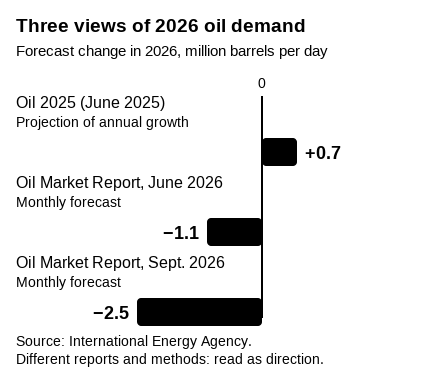
The International Energy Agency projected in June 2025, in “Oil 2025”, that petrochemicals would become the dominant source of world oil demand growth from 2026 onwards. Its September 2026 oil market report forecasts something else for 2026 itself: world oil demand falls by 2.5 million barrels per day, and petrochemical feedstock products are among the losses.
The two documents differ in kind. The projection is a modeled outlook to 2030. The forecast is a near-term estimate that the agency revises every month. Neither measures petrochemical demand, and no measured petrochemical feedstock volume appears in the documents cited here.
The difference matters to anyone weighing how far petroleum use in chemicals can be cut. The agency’s 2018 report on the industry cites the difficulty of finding alternatives for many petrochemical applications. If petrochemicals lead growth, the oil use that expands is one where substitutes are hard to find, on the agency’s account. If the 2026 shortfall lasts, the projection loses its footing. The evidence so far settles neither.
2025 projection: petrochemicals lead growth
“Oil 2025” is the medium-term oil report of the agency, an intergovernmental body. It was published on June 17, 2025, and projects to 2030. It is the newest medium-term report found; on October 9, 2026, the agency’s address for an “Oil 2026” edition returned no page.
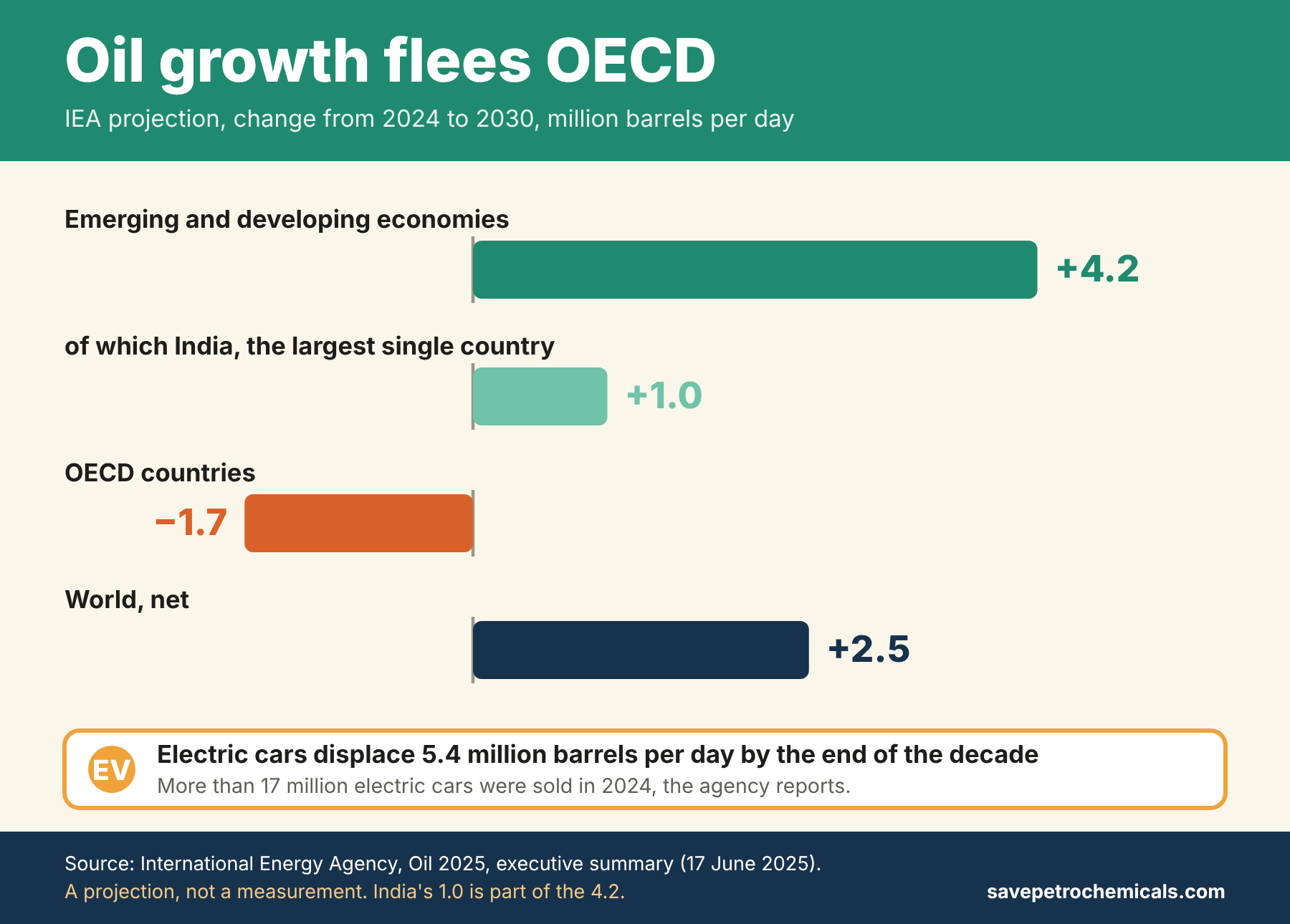
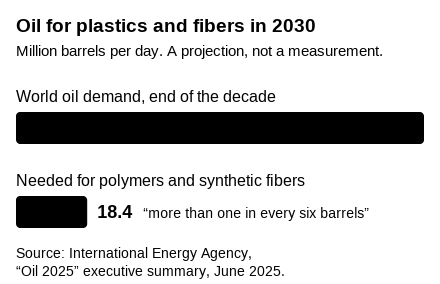
The report’s executive summary projects that world oil demand rises by 2.5 million barrels per day from 2024 to 2030 and then plateaus at around 105.5 million barrels per day. Demand in emerging and developing economies rises by 4.2 million barrels per day over that period, and India alone adds one million. Demand in the member countries of the Organization for Economic Cooperation and Development falls by 1.7 million through 2030. Polymers and synthetic fibers need 18.4 million barrels per day of oil by 2030, it says, more than one in every six barrels. These are modeled figures, not measurements.
Fuel demand is projected to flatten. The summary says demand for combustible fuels, a category that excludes petrochemical feedstocks and biofuels, may peak as early as 2027. It projects that refined products demand peaks in 2027 at 86.3 million barrels per day. Electric cars cut transport fuel demand: more than 17 million were sold in 2024, and the summary projects that they displace 5.4 million barrels per day of world oil demand by the end of the decade. It also expected sales to pass 20 million in 2025; the actual figure is not among the sources cited here.
The evidence points to petrochemicals leading growth mostly because the rest of the market is flat or falling. Total demand rises by only 2.5 million barrels per day in six years, so the lead can come from a small rise. That is a reading of the figures in the executive summary, not a statement the agency makes. Annual petrochemical feedstock volumes from the agency would test it, and none appear in the sources cited here.
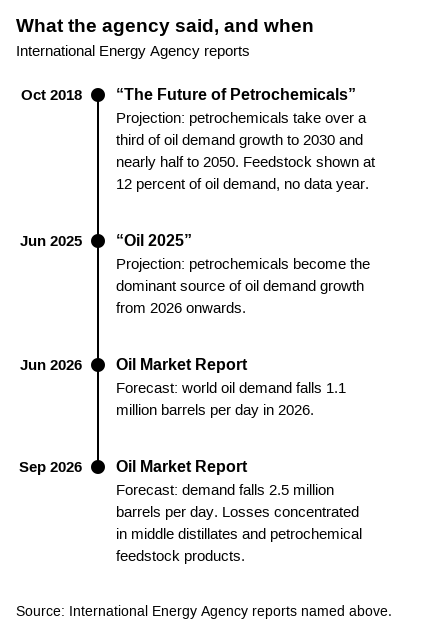
The agency made a similar call earlier. In “The Future of Petrochemicals”, published on October 4, 2018, it projected that petrochemicals would account for over a third of the growth in oil demand to 2030 and nearly half to 2050. The report’s summary adds that plastics demand has nearly doubled since 2000 and that advanced economies use up to 20 times as much plastic per person as India and Indonesia. It also puts petrochemical feedstock at 12 percent of global oil demand. It does not state the data year, and the report is eight years old, so the figure cannot be read as a current share. It also cannot be set beside the 18.4 million barrels per day projected for 2030, which is a forecast from a different report.
2026 reports: demand falling
The agency’s September 2026 report, published on September 11, forecasts that world oil demand declines by 2.5 million barrels per day in 2026 and recovers by 2.6 million in 2027. It says the losses will be concentrated in middle distillates and petrochemical feedstock products. The report points to the continuing impasse in negotiations between the United States and Iran, to higher fuel prices that weigh on consumption, notably for diesel, and to steep losses of petrochemical feedstock and refined product supplies. The June 2026 report had forecast a smaller fall of 1.1 million barrels per day for 2026, followed by growth of two million in 2027. The two are editions of one monthly forecast.
| Edition | Forecast for 2026 world oil demand |
|---|---|
| “Oil 2025”, June 2025 | Annual growth of roughly 0.7 million barrels per day in 2025 and 2026 |
| Oil Market Report, June 2026 | Down 1.1 million barrels per day |
| Oil Market Report, September 2026 | Down 2.5 million barrels per day |
Source: the International Energy Agency’s “Oil 2025”, June 2026, and September 2026 reports. All three are forecasts. The first is a medium-term projection and the other two are monthly forecasts, so the methods differ.
The fall in the September forecast equals in size the entire rise that “Oil 2025” projected for the six years from 2024 to 2030. The numbers come from different reports, so the match shows only scale.
The strongest limit on the projection is the agency’s own record. The September sentence on petrochemical feedstock gives no volume. The evidence points to a short-run shock laid over a longer-run projection, not a refutation of it, because the report blames supply losses, a diplomatic standoff, and fuel prices. A new edition of the medium-term report would show whether the agency still expects petrochemicals to lead growth.
Gas liquids, low recycling complicate substitution
In its section on the refining industry, the “Oil 2025” summary says the demand growth that refiners face is underpinned almost exclusively by petrochemicals produced from non-refined products, such as natural gas liquids. It projects that world production of natural gas liquids rises by 2.3 million barrels per day to 20.1 million by 2030. The same summary puts the rise in world oil production capacity at 5.1 million barrels per day, to 114.7 million, with crude oil capacity up 1.8 million and biofuels adding 0.68 million. Natural gas liquids make up 2.3 million of that 5.1 million, nearly half.
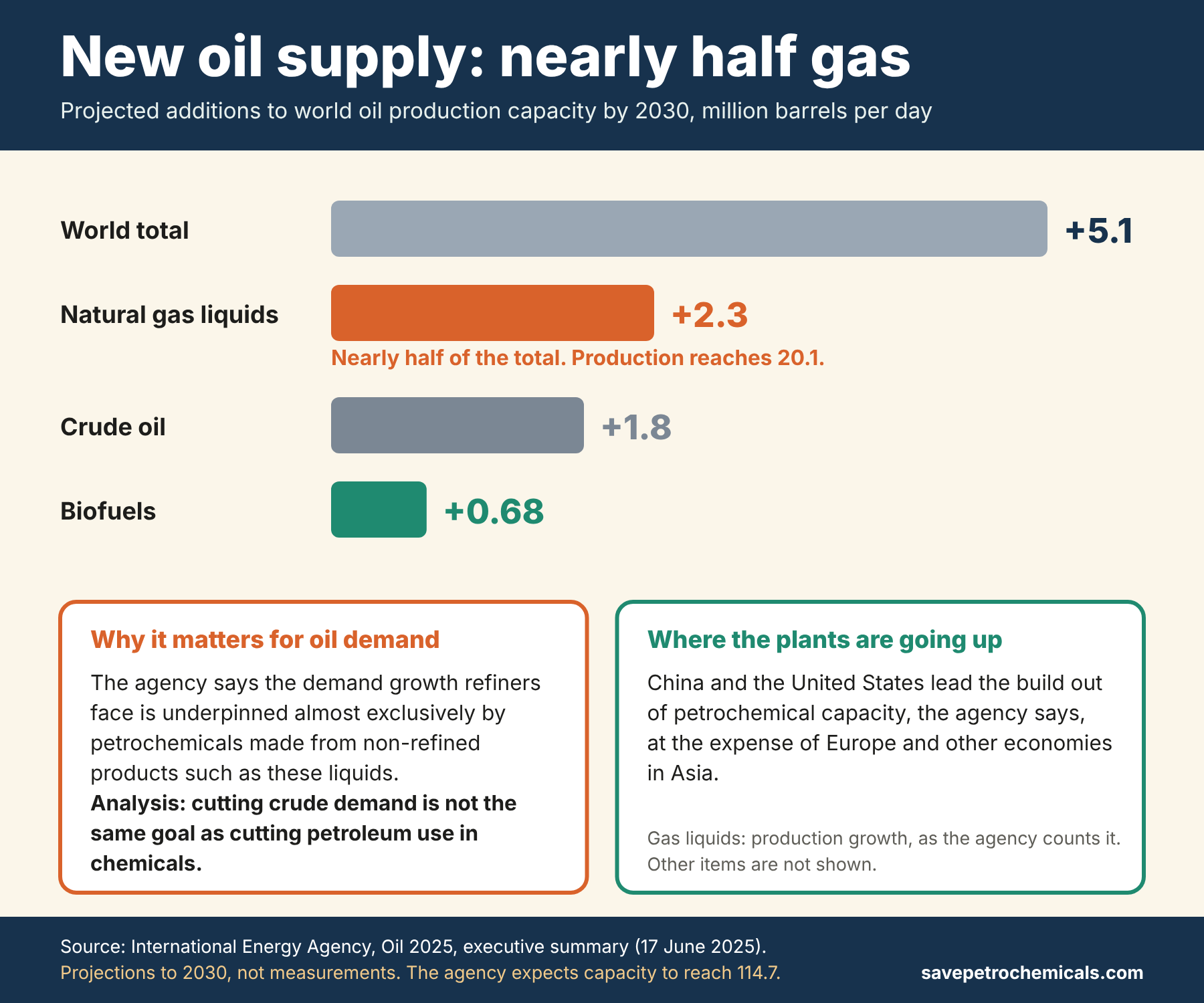
The evidence points to a gas story under the oil label. Much of the projected feedstock growth would come from natural gas liquids, not from crude refining, so cutting crude demand and cutting petroleum reliance in chemicals are different goals. That reading rests on one agency and one report.
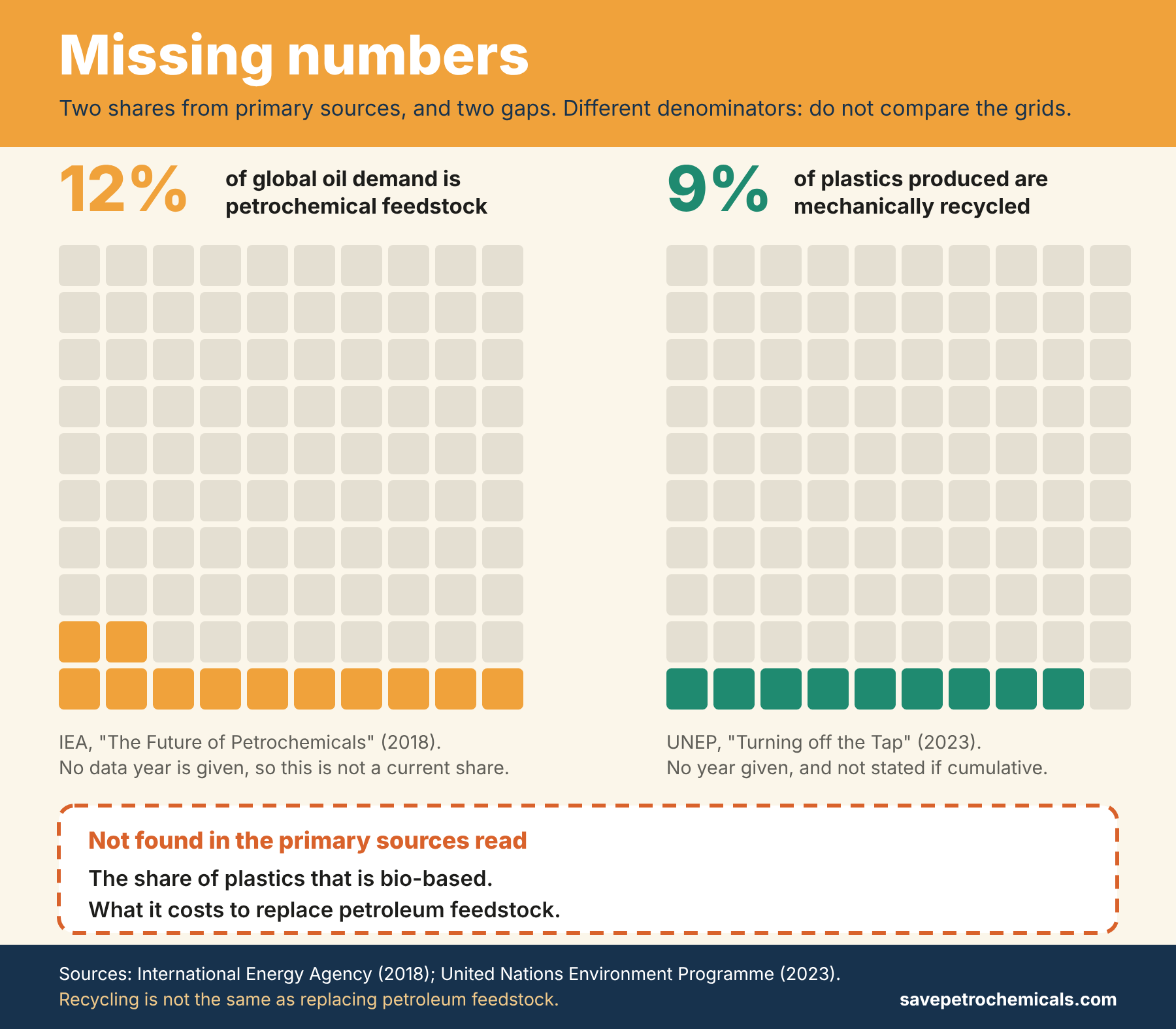
The evidence available says little about substitutes at scale. The United Nations Environment Programme reports in its 2023 “Turning off the Tap” that only nine percent of plastics produced are mechanically recycled. The page does not say which year the figure covers or whether it is cumulative. It measures recycling, not how much petroleum feedstock recycled plastic replaces. The agency’s 2018 report projects that sharply rising plastic use in developing economies will far outweigh recycling and reduction efforts in Europe, Japan, and Korea. None of the documents cited here gives a figure for bio-based supply or for the cost of replacing petroleum feedstock, so this article does not size either.
Thin support, open questions
Projections from two agencies point broadly the same way. The International Energy Agency’s “The Future of Petrochemicals” and “Oil 2025” both give petrochemicals a large share of the growth in oil demand. The United States Energy Information Administration projected in October 2021, in an article on the Reference case of its 2021 International Energy Outlook, that industrial liquid fuel use would grow three times as fast as transport liquid fuel use. The projection applies to countries of the Organization for Economic Cooperation and Development only, covers all industrial use rather than petrochemicals alone, and is five years old.
The support is thinner than it looks. The two International Energy Agency projections come from one agency and are not independent. No scenario name was found for either. The agency’s own near-term forecasts for the first year of the newer projection show a fall where the projection showed growth. No current measured share appears in the sources cited here.
The next check is the agency’s next monthly oil market report, which will show whether the 2026 fall widens or narrows. Until a report sizes the petrochemical loss, the 2026 fall and the projected 2026 lead cannot be reconciled from the sources cited here.